



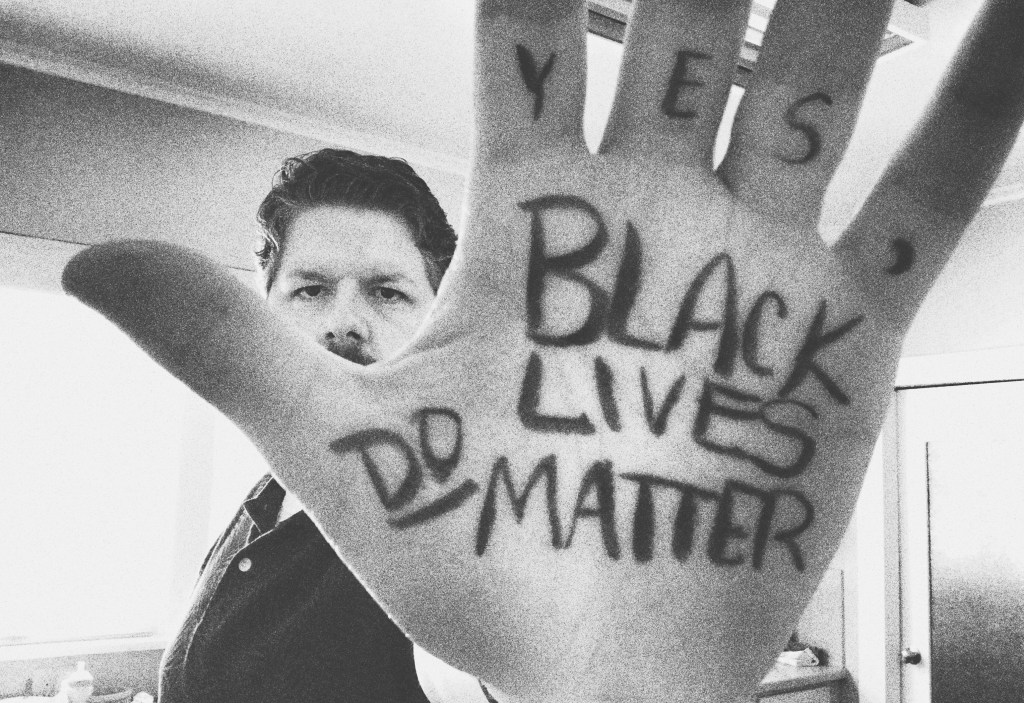
With these nationwide protests, the country is unifying in a way I’ve never seen before. For all the unity, there also seems to be a percentage of the population (*cough* some white people) who don’t understand what’s going on and use these protests as excuses to further fuel the fires that led us here in the first place. What follows is partially for the folks who hear “Black Lives Matter!” and respond with “No, All Lives Matter.”
We’re on the cusp of transformative change in this country, but that change won’t happen unless the white community understands what’s broken. We need to acknowledge our white privilege, understand our implicit biases, and create better experiences with people of color.
Understanding privilege
Several years ago, one of my best friends was telling me about some of the times in his life when he, as a black man, was a victim of racism. In this one particular incident, he and his family were at a restaurant waiting for a table. They had been there for about half an hour when a white family walked in. The hostess immediately sat the white family first.
Maybe your reaction to that story is the same mine was when I first heard it. I told him that I’ve had people come in after me and get sat first. Heck, I’ve been seated, watched someone else get sat, get their food, and pay their check before we even got our first course. I said, “I don’t know, that doesn’t really feel like racism to me. I mean, there are so many reasons why that family could have been seated first. Maybe they already had someone inside claiming the table for the group. Maybe they had a reservation. It just seems unfair to accuse the hostess of being a racist.”
That’s when he calmly explained that what I described was white privilege. Yeah, maybe what I said was true; maybe that white family had a good reason to get sat first. He said, “Brandon, in that story, when you sat at the table watching the other person get their food while you sat there, I’m sure you got frustrated at the staff or worked to come up with a logical explanation. Your privilege means you never once had to wonder if that lack of service was because of your skin color.”
And that is what made white privilege real to me.
Imagine having a cloud of doubt surround everything you do. And just when you start convincing yourself that you’re being paranoid, incidents like George Floyd’s death legitimize every fear and self-conscious doubt you’ve ever felt about how people look at you and judge everything you do. As we’ve seen nationwide, it’s more than just a silent judgment from a stranger. Black lives are in danger. Police brutality is an aspect of that danger, but it’s the tip of the iceberg. Nationwide, systemic inequality breeds lower education, higher infant mortality rates, higher rates of incarceration, higher unemployment, poorer school systems, and so on and so on.
Acknowledging inequality
White privilege masks the inequalities all around us. White privilege means that white people can look at these statistics, shake their heads, and say it’s not our fault. “If they’d just stop doing drugs and get a real job, everything would be fine.”
I think folks have a problem with the term “white privilege” because we don’t really feel privileged. After all, we worked hard for everything we have. We did well in school, which led to the opportunity to go to college. We worked hard in college, which gave us the opportunity to land our first job. We’re working hard at that job, so we can keep getting promoted. Everything in our lives came from hard work. That’s why it’s insulting to suggest that it was privilege, not hard work, that gave us everything we have.
For all of you who hate the term white privilege, or wish black people would stop using it as an excuse, let me assure you that no one is saying you didn’t work hard. We’re all super impressed. Really, we are. But, just for a moment, let’s imagine what your hard work would have looked like if you didn’t have privilege.
Remember how as a teen, you worked every summer, most evenings and weekends to save up enough money to go to college? Well, you were able to do that because you had a family who provided for the rest of your needs. Congratulations! You’re in the 92% of white families who aren’t living in poverty. If you were black, your family would have had a more than double chance of living in poverty. If you grow up in poverty, you could work just as hard, just as many hours as your white counterpart, but your money is going to pay bills, put food on the table. Whatever’s left (if anything) could be saved for college. Your odds of going to college are that much slimmer. People with college degrees earn 60% more than those who don’t. And if you have a degree, there’s a better than 95% chance that you’ll never live in poverty. If you don’t get a degree, there’s a 20% chance that you will live in poverty, starting the cycle over again.
That’s just in terms of college. At every level, there is something put in place that makes life harder for minorities. Redlining districts made it harder to move into nicer neighborhoods. People with “black” names get fewer callbacks for jobs. The criminal justice system deals harsher punishments on black offenders for the same crime.
Racial inequality is all around us
As a white person, I had to actually start looking to finally notice how prevalent inequality exists around us. Hair products and cosmetics are predominantly formulated to work best for white people. Kodak film’s standard was based on white skin tone. Facial recognition systems are only reliably accurate for white people. Motion sensors have a hard time with darker skin colors. And those are just the minor inconveniences.
There are other instances of inequality that are life-threatening for people of color. Take hoodies for example. The other day, I went for a jog – at night – wearing a hooded sweatshirt. Do you think black people feel safe going out in hoodies?
A group of white people hanging out in a parking lot – they’re just visiting. A group of black people hanging out in a parking lot – they’re a gang.
Black people live in a drastically different world than white people, and the root cause of this disjuncture is racism. There is a significant portion of the population who evaluates, stereotypes, judges and criticizes black people for no reason other than the color of their skin. The worst part is that they don’t even know it. This ignorance bred a nation of inequality. When people of influence (e.g., police officers, politicians) are blind to this bias, innocent lives are at risk.
That’s why we shout Black Lives Matter. For far too long, the system and our very way of life have been slanted to treat black people unequally and this rally cry puts a spotlight on the injustice. And that’s also why “All Lives Matter” is a racist slogan.
‘All Lives Matter’ is racism in disguise
On the surface, saying “All Lives Matter” is rooted in good intentions. After all, all lives do matter. Regardless of race, no person’s life is worth more than anyone else’s. But here’s the thing: people who angrily rebuke Black Lives Matter with “All Lives Matter!” aren’t demonstrating empathy.
Okay, to give these folks the benefit of the doubt, let’s say they’re shouting All Lives Matter in an attempt to redirect the injustice conversation to also include the person who died because he couldn’t afford medical treatment and maybe also the woman who died at the hands of her abusive husband. Even IF that’s what All Lives Matter is meant to communicate, that’s not what we hear.
The phrase All Lives Matter sounds like it’s just removing race from the issue, but what it’s actually doing is blaming race.
Let me translate “All Lives Matter”:
“I hear what you’re saying with Black Lives Matter, but listen up. Race has nothing to do with it. Innocent people need to stop dying. I know you keep saying that there’s inequality in this country, but I don’t believe that. All people have an equal chance to be successful and some people just don’t take advantage. Oh, it’s not my fault that those people who don’t take advantage are black. I don’t even see color. It’s not my fault that they’re black. Black people make their own problems. If they’d just act more white, maybe they’d have an easier time.”
All Lives Matter is a statement of disagreement, but above all, it’s saying you don’t want to level the scales. “All Lives Matter” is another way of saying you’ll do nothing. And when you do nothing despite the overwhelming evidence that the system is unfair to black people, you are basically saying their lives don’t mean as much as your own. And that’s racist.
What is racism?
Racism is the belief that a person of a different race is somehow inferior to your own.
That’s it.
You might be a racist if…
Maybe the definition is too vague. Let’s take a cue from Jeff Foxworthy and play a game called “You might be a racist.”
If you’ve ever seen a black person get killed and thought, “They’d still be alive if they didn’t break the law” OR “They shouldn’t have worn that hood over their head and walked alone at night”…you might be a racist.
If you’ve ever seen a group of black people and felt afraid…you might be a racist.
If you ever made fun of a black person’s name…you might be a racist.
If you’ve ever seen rioting over a black person’s death and felt more sorry for the police…you might be a racist.
If you’ve ever said, “I hate that black people are dying, but this looting has to stop”…you might be a racist.*
If you think black people cause their own problems…you might be a racist.
If you think all the protests going on right now are too much…you might be a racist.
If you think people are going overboard with this Black Lives Matter stuff…you might be a racist.
If you think removing Confederate statues and memorials is erasing history…you might be a racist.**
If you hear stories of black people being killed while in custody and you shrug your shoulders…you might be a racist.
If you don’t want to change any laws or policies out of fear of the consequences…you might be a racist.
If you’re uncomfortable around black people…you might be a racist.
If you’ve ever demonstrated any preference toward your own race over another…you might be a racist.
The Implicit Bias
Was it hard to read through that list? Maybe some hit too close to home. The way I see it, two factors are influencing us all the time. First, our human nature resists change. Change is scary, and the unknown can be terrifying. Yes, maybe you do agree that we need to change laws and policies that keep suppressing minorities, but what if the solution ends up worse than the original problem? On top of that, it’s much easier to support others’ rights as long as they don’t infringe upon your own. If there’s a threat to your own rights, it’s natural that you’d resist it.
Secondly, we all have an implicit bias. All of us have developed attitudes and stereotypes that are unconsciously affecting our understanding, actions and decision making. Our experiences in life, the media we consume, the stories we’ve been told, the people we’ve known – everything has burrowed its way into our brain and is affecting our thoughts in ways we don’t realize.
For instance, let’s say you have an emergency, and in this moment of crisis, you can either run toward a white person for help or you can run toward a black person for help. Studies show people have a preference to run toward someone of their same race. It’s not a conscious decision; your instinct tells you where to go.
This same idea applies in all sorts of ways. If you ever feel uncomfortable around someone because of the color of their skin, the way they talk/act, or even the way they’re dressed, that feeling was influenced by your past experiences (or lack thereof). An implicit bias is learned and developed over time. Sure, it unconsciously drives your behavior, but that bias is learned. And since it’s learned, it can be changed if you give yourself the right experiences.
Implicit biases are what created the nation’s systematic inequality in the first place. Implicit bias is what kept black people in slavery. Implicit bias is what squandered black people’s opportunities when slavery was abolished. Implicit bias drove the Jim Crow laws. Implicit bias is what kept black families in the redlined districts. Implicit bias is what built a system that keeps the black community in a cycle of poverty, where they are forced to make impossible decisions that keep them in the law’s crosshairs.
And yes, implicit biases are why police officers are much more likely to use lethal force on a black person compared to a white person. A few years back, I listened to a podcast where they interviewed a police officer about the bias that affects his job. He said, “When you arrest four black men back-to-back for violent crimes, what do you think our attitude is when we face that fifth one?”
Right now, someone is reading that statement, thinking, “See, no wonder black people are hurt more by the police. It sounds like they’re more violent anyway. How can an officer tell the violent ones from the civil ones?”
That is the absolute wrong takeaway, and it’s that very misunderstanding that keeps lawmakers from making any changes to police procedures.
We shouldn’t look at that police officer’s statement as evidence that black people are more violent. We should look at that with shame. The police officer didn’t give himself the opportunity to have positive experiences with black people. His only encounters with them are when they’re in trouble. Outside of work, he lives in a bubble with people who look and sound just like him. When he ignores his implicit bias, he’s setting himself up to have more of these lethal encounters in the future.
The best way to fight your implicit bias is by admitting that you have one, then creating experiences to change it.
What white people can do right now
Racism isn’t a switch you can just flip off. You can’t just call someone a racist and expect that to bring change. Most people who are racist don’t even realize it. All of us have an implicit bias that’s driving our behaviors, whether we know it or not. Some of those implicit biases are rooted in race. But all implicit biases are learned behaviors that you can change, starting today.
Here are some items for introspection:
- Think about your life up to this point. What would have been different if you were born with a different skin color?
- Ask yourself what you think of other races/cultures. What assumptions do you make?
- What situations make you uncomfortable? Do any of those have anything to do with race?
- How would you feel if you were the only person of your skin color surrounded by people of a different skin color?
Here are some ideas to get some positive experiences:
- If your office has a diversity council or employee advocacy group, join it.
- Reach out to a black person you know and ask them how they’re doing in the midst of all that’s going on.
- Ask questions! Do not be afraid to ask a person of color about life or what you can do. It can seem awkward, but most people will respond well when they know you’re trying to take steps to improve yourself.
- Read stories by black authors. Watch movies by black directors. The best way to get a glimpse behind the curtain is to seek out pop culture that’s from a different perspective.
- Attend rallies and protests. Use the opportunity to listen to what people are saying. Use the opportunity to make new friends.
- Connect with people outside your social circle; invite people of color to your home for a meal.
Lastly, here are some ideas to start bringing change:
- Pay attention to your local ballots. Mayors, commissioners, sheriffs, judges…these are all elected officials and are very influential in improving the status quo in your community.
- Write to your state and federal congress members. Let them know that you support the Black Lives Matter movement and you want to see sweeping changes in police brutality. An easy way to do that is to sign up with Resistbot. Just text “resist” to 50409.
- Advocate for demands brought forth by advocacy groups. For example, NAACP has a list of demands to bring an end to police brutality. They’re all very practical and easy to support. Share them on social media. Talk about them with your friends.
The path ahead
The nationwide protests are an amazing step in the right direction. A spotlight is on inequality in a way that it’s never been before. But even with that, my heart is still broken. I fear for what the future will bring. Unless we can all take a stand against bigotry and racism, the problem will never go away.
One important footnote to all of this is the issue of rioting and looting. Understand, no one is pro-looting. Nobody. It’s not helpful to condone looting. We all hate it. And just because someone understands it, doesn’t mean they agree with it. There’s so much bottled up anger, generations of suffering and injustice, that when you react to a peaceful protest with a military response, violence is a natural outcome.
The world need not succumb to violence. The minority wouldn’t have to shout so loud to be heard if there were more voices saying the same thing. There is strength in numbers and every single person needs to take action to save lives.
Additional Resources:
- Here’s an excellent story from the podcast This American Life where they look at the Las Vegas Police Department and the steps they’ve taken to make extremely positive steps away from brutality against the black community: https://www.thisamericanlife.org/548/cops-see-it-differently-part-two/act-two
- The Criterion Collection and IFC are streaming movies by black directors for free on their app. More information: https://www.wmagazine.com/story/criterion-ifc-black-director-films/
- Here’s an episode of 99 Percent Invisible that talks about Confederate statues: https://99percentinvisible.org/episode/notes-imagined-plaque/
- www.Resist.bot
- www.NAACP.org
- http://kirwaninstitute.osu.edu/research/understanding-implicit-bias/
Footnotes:
* This one might need explaining. Instead of saying “I hate that black people are dying, but this looting has to stop,” try saying, “I hate this looting, but black people have to stop dying.” See the difference?
** Memorials are historical, but they’re not history. And if you look at the timeline of when these statues were built, you’ll see they were installed as a response to black people getting more freedom. Most were built during the Jim Crow era. Our support of these statues – which exist in 31 states, far more than the 11 Confederate states – is appalling. The Confederate army was an enemy of the United States. We’ve forgotten that somewhere along the line. It’s impossible to both love this country and continue to celebrate the Confederate States of America.
 The Not-The-Mama Dad Blog
hello I love the header of your blog, it is a personal creation? Zaneta Gayle Ferrel
LikeLike
Thank you! Yep, it’s my design.
LikeLike